Contact us
Published:
20.1.2026
Last Updated:
22.1.2026
20.1.2026

Malta Residence, Tax and Citizenship Options for British Nationals

By
Antoine Saliba Haig
(
Partner, Immigration & Global Mobility
)
Magdalena Velkovska
(
Director, Private Client Tax
)
what's inside

Amid a backdrop of ongoing geopolitical and economic uncertainty, an increasing number of British nationals are reassessing their long-term residence and mobility options within Europe. Since the United Kingdom’s departure from the European Union, relocating to an EU country is no longer as straightforward by virtue of exercising right of freedom of movement.  Furthermore, following the abolition of the British Non-Dom tax system, structured residence and citizenship pathways are becoming essential for UK citizens seeking security, flexibility, and lifestyle benefits.

full article

Copyright © 2025 Chetcuti Cauchi. This document is for informational purposes only and does not constitute legal advice. Professional legal advice should be obtained before taking any action based on the contents of this document. Chetcuti Cauchi disclaims any liability for actions taken based on the information provided. Reproduction of reasonable portions of the content is permitted for non-commercial purposes, provided proper attribution is given and the content is not altered or presented in a false light.

continue learning
what's inside

Amid a backdrop of ongoing geopolitical and economic uncertainty, an increasing number of British nationals are reassessing their long-term residence and mobility options within Europe. Since the United Kingdom’s departure from the European Union, relocating to an EU country is no longer as straightforward by virtue of exercising right of freedom of movement.  Furthermore, following the abolition of the British Non-Dom tax system, structured residence and citizenship pathways are becoming essential for UK citizens seeking security, flexibility, and lifestyle benefits.

  • Malta offers a familiar, English‑speaking EU environment where integration is seamless for UK nationals
  • The MPRP grants long‑term EU residence with family inclusion and no relocation or language requirements
  • GRP and MRP offer favourable tax treatment through the remittance‑basis system and low effective tax exposure
  • Citizenship options open access to a high‑ranking EU passport with freedom of movement and generational rights
  • Malta combines stability, accessibility, and a highly advantageous legal‑tax framework for UK citizens planning a European base.

Malta, an English-speaking EU Member State located in the heart of the Mediterranean, has emerged as one of the most accessible and familiar destinations for British nationals. It offers a range of legal pathways, including the Malta Permanent Residence Programme (MPRP), the Global Residence Programme (GRP) for tax-focused residence, Malta Retirement Programme (MRP) designed for international retirees, and Malta Citizenship by Merit, a discretionary naturalisation route for individuals able to make an exceptional contribution to Malta.

Why Malta?

Relocating abroad is an aspiration shared by many, and Malta has steadily emerged as a preferred destination for British nationals seeking a new European base.

The Maltese islands offer a compelling combination of lifestyle, good climate, low utility bills, stability, and accessibility. As a secure EU Member State where English is one of the two official languages, integration is seamless. English is spoken fluently across government, business, and daily life. For UK nationals, this removes one of the most significant barriers often encountered when relocating elsewhere in Europe.

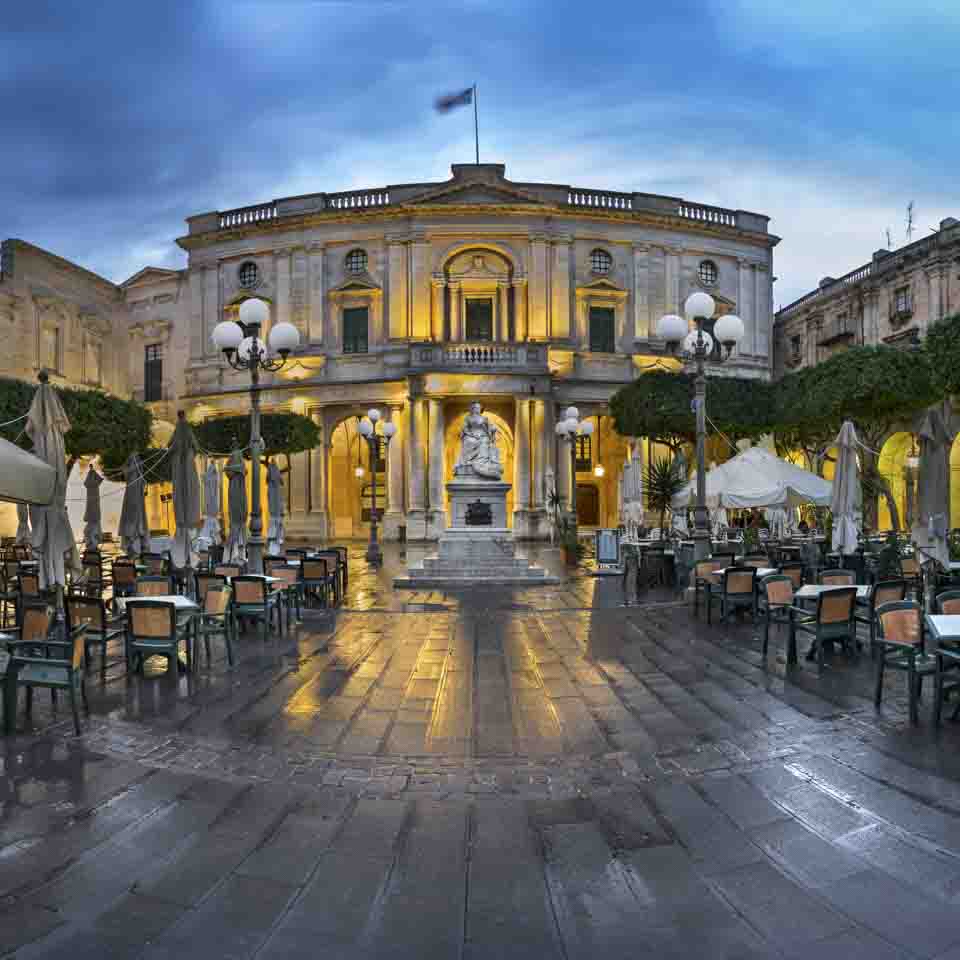
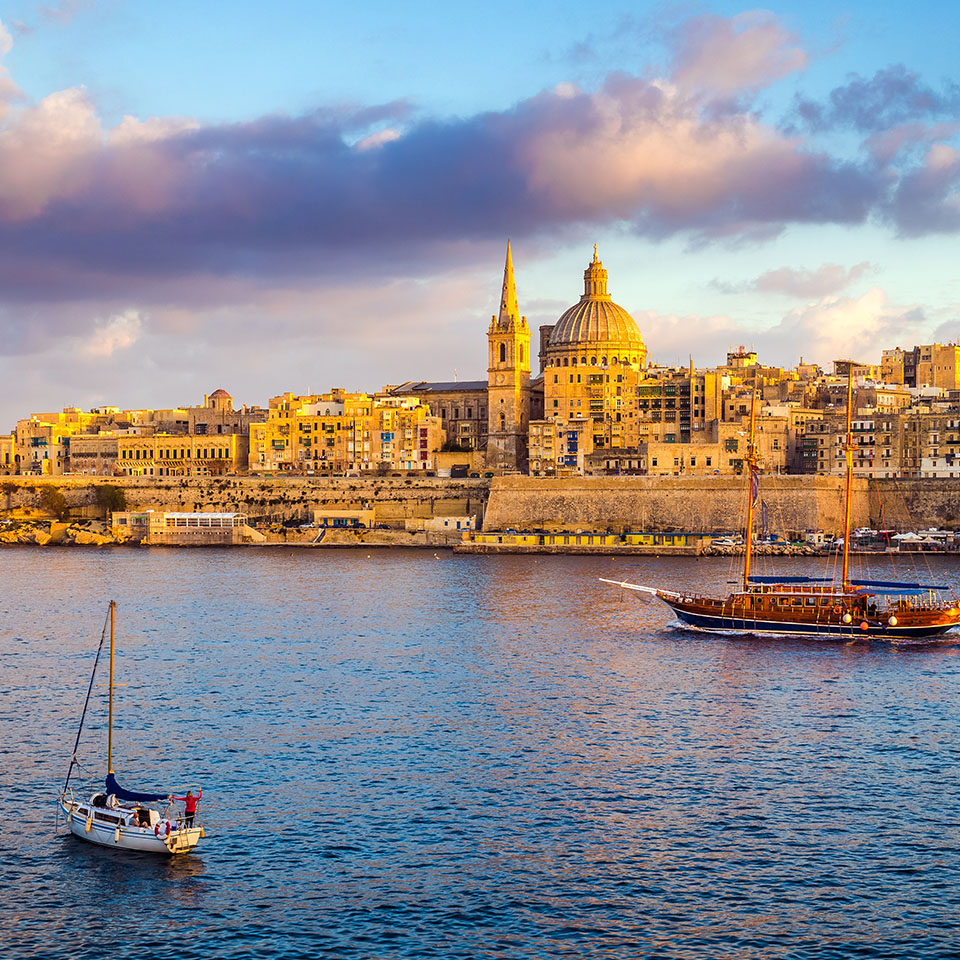
Despite its compact size, Malta offers remarkable cultural and historical depth. Ancient megalithic temples older than the pyramids, grand Baroque architecture, and the fortified capital city of Valletta — a UNESCO World Heritage Site, reflect layers of Phoenician, Roman, Arab, Norman, and British influence. Daily life is straightforward, with short travel distances, efficient services, and easy access to the sea.

Malta is equally renowned for its natural beauty. Crystal-clear waters, dramatic cliffs, hidden coves, and iconic locations such as the Blue Lagoon on Comino create an exceptional outdoor lifestyle. With approximately 300 days of sunshine each year, Malta offers a climate that contrasts sharply with the UK’s, supporting year-round outdoor living.

From a practical standpoint, Malta benefits from a comparatively lower cost of living than many Western European countries, a strong public and private healthcare system, and one of the lowest crime rates in the European Union. Its vibrant social and cultural life caters to all ages, complemented by a culinary scene that blends traditional Mediterranean flavours with a growing number of internationally recognised restaurants.

Life After Brexit: Residence Rights for British Nationals

Following the United Kingdom’s withdrawal from the European Union on 31 December 2020, British citizens no longer enjoy freedom of movement within the EU. As a result, UK nationals wishing to live in Malta must now formally acquire the legal right to reside through an approved residence route.

Residence in Malta is secured by applying for a residence permit through the relevant Maltese authorities, granting the right to live on the islands on a long-term or permanent basis. Unlike the pre-Brexit position, residence must now be planned, applied for, and maintained in accordance with Maltese immigration law.

For many British families, retirees, entrepreneurs, and internationally mobile individuals, this shift has prompted a reassessment of European planning — with Malta standing out as one of the most practical and familiar EU jurisdictions for UK citizens.

Residence vs. Tax Residence vs. Citizenship: Key Differences

Residence, Tax Residence and Citizenship represent three distinct legal/tax statuses.

Residence (immigration status) grants the right to live and work in Malta under the issued residence permit, together with limited travel rights within the Schengen Area.

Tax Residence (residence for tax purposes) is a status determined under Maltese tax laws. It is generally assessed based on the number of days spent in Malta or whether the individual can be regarded as demonstrating intention to reside in Malta, taking into account their overall circumstances and activities.  This distinction is important, as an individual’s tax residence status will affect how they are taxed in Malta.

Citizenship, by contrast, represents full membership of the Maltese state. It confers a Maltese passport, full EU freedom of movement, consular protection abroad, and the ability to pass citizenship to future generations.

These distinctions are important in practice. From an immigration perspective, understanding the difference between residence and citizenship helps determine the most appropriate route depending on the client’s desired immigration status and long-term mobility objectives. Separately, holding a residence permit (as an immigration authorisation) should not be confused with tax residence, which is a tax status assessed independently and is not acquired automatically by obtaining a residence permit.

Malta Permanent Residence Programme (MPRP)

The Malta Permanent Residence Programme (MPRP) is administered by the Residency Malta Agency and grants lifelong permanent residence from approval. It is particularly suited to British nationals seeking long-term security in the EU without mandatory relocation.

Key Features and Benefits

  • Indefinite right to live and work in Malta
  • Visa-free travel within the Schengen Area (90 days in any 180-day period)
  • Single application covering spouse or partner (including same-sex), dependent children up to age 28, and dependent parents or grandparents
  • Children retain permanent residence for life, even after marriage or financial independence
  • No minimum stay requirement, language test, or relocation obligation

Core Requirements

  • Administrative fee: €60,000 (main applicant) plus €7,500 per adult dependent
  • Government contribution: €37,000 (payable within eight months of approval)
  • Property: Purchase from €375,000 or rent from €14,000 per year
  • Philanthropic donation: €2,000 to a registered Maltese NGO
  • Health insurance: Comprehensive coverage in Malta

Malta Global Residence Programme (GRP)

The Global Residence Programme (GRP) provides a tax-focused residence option for British nationals who wish to establish residence in Malta without seeking permanent residence or citizenship.

The programme allows UK citizens to benefit from a favourable personal tax framework, under which qualifying foreign-source income remitted to Malta is taxed at a flat rate of 15%, subject to a minimum annual tax payment of €15,000. Foreign income not remitted to Malta and capital gains arising outside Malta are not subject to Maltese tax.

Malta Retirement Programme (MRP)

The Malta Retirement Programme (MRP) is a suitable residency option for British retirees, who, in addition to the residency permit, wish to benefit from the special tax status providing for a 15% tax rate on remitted income (similar to the GRP), subject to a minimum annual tax of €7,500.  

Under both the GRP and the MRP, applicants must acquire or lease qualifying residential property in Malta, maintain comprehensive health insurance, and demonstrate financial self-sufficiency/or be in receipt of pension, respectively.  While the GRP/MRP are not permanent residence routes and do not provide Schengen travel rights equivalent to the MPRP, they offer lawful residence in Malta, paired with one of the EU’s most attractive personal tax systems – the remittance basis of taxation.

Under Malta’s resident but not domiciled (“Res, Non-Dom”) personal tax framework, foreign-source capital gains are not subject to Maltese tax, even if remitted to Malta.  Foreign-source income is similarly not taxable in Malta, except to the extent that it is remitted to Malta.  

For many British nationals post-Brexit, the GRP/MRP serves as a strategic alternative or complement to permanent residence, particularly where tax residency and lifestyle flexibility are the primary objectives.

Malta Citizenship by Merit

Malta’s Citizenship by Merit route operates as a naturalisation pathway under Maltese nationality law and was refined through reforms implemented in 2025.

This pathway is reserved for individuals whose exceptional achievements, services, or contributions are clearly deemed to be in Malta’s national interest. Applications are assessed on a case-by-case basis and may relate to fields such as entrepreneurship, innovation, science, technology, culture, sport, education, philanthropy, or social impact.

Authorities assess both past accomplishments and future commitments, focusing on tangible benefits to Malta such as job creation, innovation, cultural or educational advancement, and long-term economic or social sustainability. Successful applicants may include immediate family members and, if approved, are granted full Maltese citizenship.

Maltese citizenship provides access to a highly ranked passport offering visa-free or visa-on-arrival access to over 190 destinations, full EU freedom of movement, consular protection abroad, and the ability to pass citizenship to future generations. Malta permits dual nationality, meaning British citizens are not required to renounce their UK citizenship.

Malta Citizenship by Descent

For some British nationals, Maltese citizenship may be available by descent, offering a direct route to EU citizenship without the need for investing.

Maltese nationality law allows individuals to claim citizenship by descent where they can demonstrate a qualifying lineage to Malta. In practice, this often applies where an applicant can establish at least two consecutive generations of ancestors who were born in Malta, typically a parent and grandparent, or grandparent and great-grandparent, depending on the specific circumstances.

Each application requires a detailed assessment of family lineage, including the verification of Maltese birth, marriage, and other civil status records, as well as confirmation that citizenship was transmitted in accordance with Maltese nationality law in force at the relevant time. Documentary evidence is critical, and eligibility must be assessed on a case-by-case basis.

Tax Framework for British nationals Moving to Malta

Obtaining Maltese immigration status - whether through a residence permit or citizenship - does not, by itself, trigger Maltese taxation. These are generally tax-neutral events. An individual’s Maltese tax position is instead driven by Malta’s key connecting factors, (tax) residence and domicile.

Malta does not operate a statutory “residence test” (such as the UK Statutory Residence Test), nor does it apply deemed domicile rules. Whether a person is treated as tax resident in Malta is assessed based on the relevant facts and circumstances.

As a general rule, individuals who are tax resident in Malta are subject to tax on Maltese-source income and gains, as well as on foreign-source income to the extent it is remitted to Malta (the remittance basis). Foreign-source capital gains are generally not taxable in Malta, even if remitted, where the individual is resident but not domiciled in Malta.

By contrast, individuals who remain non-resident for Maltese tax purposes (for example, because they retain tax residence elsewhere, even if they hold a Maltese residence permit under programmes such as the MPRP) are typically taxable in Malta only on income and gains arising in Malta (the source basis).

Given the above, pre-immigration planning is essential to ensure that the intended immigration route aligns with the individual’s tax profile and objectives. In practice, early planning can help manage the timing of arrival, anticipated remittances, asset and income flows, and the overall structure of the move - avoiding unintended tax outcomes and ensuring the relocation is both compliant and efficient.

Malta as Your European Option

For British nationals, Malta offers a rare balance of familiarity and opportunity. The MPRP provides a clear, family-inclusive route to permanent EU residence post-Brexit, the Global Residence Programme offers a tax-efficient lifestyle solution, and Citizenship opens the door to full EU citizenship for those able to contribute meaningfully to Malta’s future.

With its English-speaking environment, robust legal framework, favourable tax landscape, and outstanding quality of life, Malta remains one of the most compelling European destinations for UK citizens planning their next chapter. Get in touch with us to explore the best option for you.

Copyright © 2025 Chetcuti Cauchi. This document is for informational purposes only and does not constitute legal advice. Professional legal advice should be obtained before taking any action based on the contents of this document. Chetcuti Cauchi disclaims any liability for actions taken based on the information provided. Reproduction of reasonable portions of the content is permitted for non-commercial purposes, provided proper attribution is given and the content is not altered or presented in a false light.

Contact us

Speak to a
recognised expert